Blog
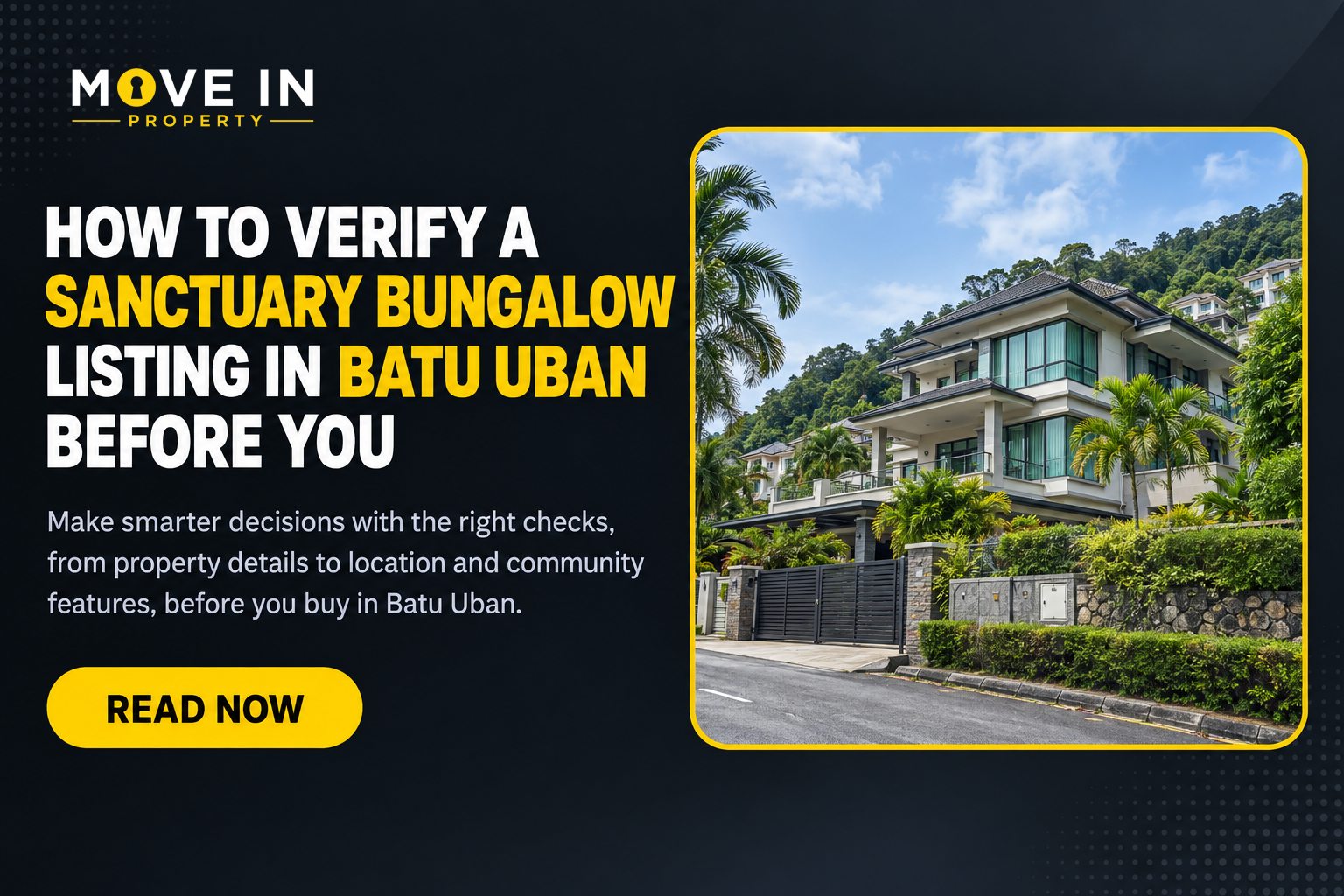
How to verify a Sanctuary bungalow listing in Batu Uban before you enquire
Do not assume that every listing for a The Sanctuary bungalow describes the same type of house, size or value. Advertised properties in this development can differ in land area, built-up area, floor count, furnishing, renovation status and asking price. Before sharing personal details or arranging a viewing, identify the exact unit and ask the advertiser to confirm the details that matter.
The Sanctuary is described in supplied property material as a gated hillside community in Batu Uban, Gelugor, Penang, with views towards Penang Bridge and the sea. However, that development-level description does not prove the condition or specifications of an individual property. For broader context, see the full guide to The Sanctuary bungalows, then use the checks below for the specific listing.
Start with the exact unit, not just “The Sanctuary bungalow”
Ask for the complete address, house or unit reference and the advertiser’s current availability status. “The Sanctuary” identifies the development, but it does not identify the particular bungalow being offered. This distinction matters because the estate also includes semi-detached houses and town villas, not only bungalows.
Check the building description and number of storeys against the supplied advertisement. Some The Sanctuary properties described in the advertisements as bungalows are multi-storey detached homes. Do not assume that a listing labelled “bungalow” is single-storey: ask the advertiser to confirm whether the property has two or three storeys before comparing it with another listing.
Use the Batu Uban and Gelugor location as a basic identity check, not as proof that the listing is genuine or current. The development’s gated hillside setting can help you recognise whether the photographs and description appear consistent, but the exact address and property reference remain more useful for verification.
The supplied development description identifies The Sanctuary in Batu Uban, Gelugor, as a completed, freehold, gated-and-guarded hillside residential enclave. It also mentions Runnymede. Treat these points as development-level context, not proof of the individual listing. Confirm that the particular house is within The Sanctuary, then ask for property-specific information about tenure, condition, renovation and current availability before relying on the description.
Compare the listing particulars line by line
Copy the important details from the listing into your notes before contacting the advertiser. Compare the land area, built-up area, number of storeys, bedrooms, bathrooms, furnishing, renovation condition, tenure and asking price. Do not combine details from two advertisements simply because both use the name The Sanctuary.
For example, one advertised three-storey bungalow is described as having approximately 6,091 sq ft of land, 4,900 sq ft of built-up area, five bedrooms, six bathrooms, freehold tenure and an asking price of RM3.7 million. Another advertised renovated and furnished three-storey corner bungalow is described as having approximately 6,500 sq ft of land, 6,770 sq ft of built-up area, six-plus-two bedrooms, seven bathrooms, freehold tenure and an asking price of RM6 million. These are listing-specific descriptions, not specifications that apply to every bungalow in the development.
Advertised prices should also be treated as asking prices rather than confirmed transaction values or market valuations. Search results show examples ranging from about RM3.7 million to RM6 million, alongside different land and floor areas. The useful conclusion is not that one figure represents the market; it is that like-for-like comparison is essential.
If another listing describes a two-storey semi-detached property at The Sanctuary with approximately 4,000 sq ft of land, 3,100 sq ft of built-up area, four-plus-one bedrooms, four bathrooms and an asking price of RM2.65 million, do not use it as a direct bungalow comparison. It may help you recognise the importance of property type, but it is not evidence of the value of the bungalow you are considering.
Are bungalows cheaper than a house? There is no universal answer because a bungalow is itself a type of house, and the asking price depends on the property being compared. The Sanctuary examples show a wide variation: advertised bungalow prices ranged from about RM3.7 million to RM6 million, while a semi-detached listing was advertised at about RM2.65 million. The properties differed in land area, built-up area, floor count, bedrooms, bathrooms and renovation or furnishing level. These are asking prices, not proof that bungalows are always more expensive or cheaper. Compare like-for-like properties and, where possible, verify recent transaction evidence rather than relying on portal prices alone.
Use this pre-enquiry verification table
Send the advertiser a focused set of questions rather than asking only whether the property is still available. The following table turns each material claim into a practical next step.
| Detail to check | What to ask for or confirm | What a mismatch means | Next action |
|---|---|---|---|
| Exact identity | Full address, house or unit reference and current availability | The advertisement may describe another or outdated property | Pause and request the correct listing particulars |
| Property type | Detached or semi-detached, plus the actual number of storeys | “Bungalow” may not describe the building in the way you expect | Ask for a written clarification and matching photographs |
| Land and built-up areas | The figures for this specific house, not a nearby or older listing | Portal details may have been copied, changed or combined | Request supporting sale particulars and verify before negotiating |
| Condition | Whether the house is furnished, renovated, partly renovated or sold as-is | Photographs may not reflect the current condition | Ask for recent photographs and inspect the property in person |
| Tenure | Whether the stated tenure applies to the particular property | A development-level description does not prove an individual title position | Ask the seller or qualified property professional what document confirms it |
| Asking price | Current asking price and what date the figure applies to | Old or duplicated prices can distort comparisons | Record the figure and compare only similar properties |
| Advertiser authority | Whether the contact is the owner or acting for the owner, and how viewings are arranged | You may not be dealing with the party able to answer material questions | Request the appropriate confirmation before making payment |
Listing details, prices and condition require verification. The aim is not to prove a problem from one inconsistency; it is to identify which facts remain unconfirmed before you invest time, disclose sensitive information or discuss an offer.
Keep asking prices and property evidence separate
A higher asking price may reflect a larger plot, greater built-up area, a corner position, renovation, furnishing or a different presentation of the property. It does not by itself prove better value. Likewise, a lower price does not prove a defect. Write down the exact unit details and compare properties only after adjusting for the features that are actually confirmed.
Decide what to do when details do not match
Proceed to a preliminary enquiry when the exact unit, location, property type and core advertised figures are consistent, and the advertiser can explain the viewing process. Keep the enquiry limited to verification until the material details are confirmed.
Pause when the listing uses different land or built-up figures across platforms, omits the floor count, uses photographs that appear to show another house, or cannot confirm whether the property is currently available. A mismatch is not automatically proof of fraud, but it is a reason to request clearer evidence before progressing.
Stop or seek qualified professional help when the advertiser cannot credibly establish which unit is being offered, who has authority to market it, or why payment is being requested. Do not treat a portal listing, asking price or verbal description as a substitute for checking the relevant property documents. For inspection priorities and broader purchase considerations, you can also read the Sanctuary bungalow buyer’s checklist.
The listing itself does not establish whether the property is being offered by the owner, an authorised representative or another advertiser. Before paying or sharing sensitive information, ask for the complete address or unit reference, confirm that the advertised property is still available, and request the property particulars and documents relevant to the proposed transaction. Treat any market-status or sales-channel statement as unverified unless it is supported by current evidence.
Before you enquire: a final message checklist
Your first message can be short and specific. Ask the advertiser to confirm:
- the full address and exact house or unit reference;
- whether the property is detached or semi-detached and how many storeys it has;
- the current land area, built-up area, bedroom and bathroom count;
- the stated tenure and current asking price;
- whether the house is furnished, renovated or sold as-is;
- whether it is still available and whether the photographs are recent;
- whether the contact is the owner or is authorised to arrange the viewing.
Save the reply and compare it with the advertisement. If the answers change the property’s identity, size, condition or price, ask for an explanation before booking a viewing. You can then arrange an on-site inspection with a clearer understanding of what still needs confirmation.
Frequently Asked Questions
If different portals show different sizes, which figure should I trust?
Trust neither portal automatically. Ask for the figures that apply to the exact house and request the relevant sale particulars or property documents for confirmation. Different advertised listings at The Sanctuary show materially different land and built-up areas, so a portal snapshot should be treated as a starting point rather than final evidence.
What should you confirm when a Sanctuary listing says “bungalow”?
Use “bungalow” as a description to verify, not as proof that the property has a particular layout. Ask the advertiser to confirm the exact floor count, building type and layout, then compare the listing only with properties that have similar confirmed particulars.
Are the advertised RM3.7 million and RM6 million prices market values?
There is no universal answer: a bungalow may be advertised at a higher or lower price than another type of house, depending on what is being compared. The supplied The Sanctuary examples included bungalow asking prices of about RM3.7 million to RM6 million and a two-storey semi-detached listing at about RM2.65 million, but the properties differed in land area, built-up area, floor count, bedrooms, bathrooms and renovation or furnishing level. For an enquiry, compare only listings with similar property types and specifications rather than treating one advertised figure as a general rule.
What is the safest first step before arranging a viewing?
A useful first step is to obtain written confirmation of the exact unit, current availability, property type, floor count, key dimensions, tenure, asking price and advertiser authority. Use those details to decide which questions can be answered during a viewing and which require verification by a qualified professional.
Make your enquiry more useful
Use the checklist above before contacting the advertiser, and keep the listing response with your property notes. For wider planning, review the guide to Sanctuary bungalow running costs and upkeep after you have confirmed that the listing describes the right house.